Hours, prices and access verified by the Dijon Wine Tours team — last checked 2026-09-25.
Dijon's wine tours start from seven kerbs in the centre and three in Beaune,
and the vines begin where the city ends. Get the layout straight here: where you meet, which
way the road runs, and where each day turns back. It makes choosing among the
wine tours from dijon easier.
Where each tour starts in Dijon
Every shared day names its own kerb. The table gives the address and the time, so you
can find yours on a street map the night before.
Kerb
Address
Time
What leaves from it
Place Darcy
Maison Divia, 16 Place Darcy
9 am or 9:45 am
The Ophorus full day, half-day and villages day; the 9:45 am full day
Place Darcy car park
Beside Darcy park
By the slot you book
The Côte de Beaune half-day and the morning-or-afternoon Côte de Nuits half-day
Saint-Bénigne
In front of the church
9 am or 9:45 am
The lunch days and the Côte de Beaune e-bike day
Rue Monge
Bourgogne Évasion, 78 rue Monge
9:30 am or 2:30 pm
The Côte de Nuits e-bike day; the city ride
La Cave du Palais
Hôtel du Palais, near Place de la République
By the slot you book
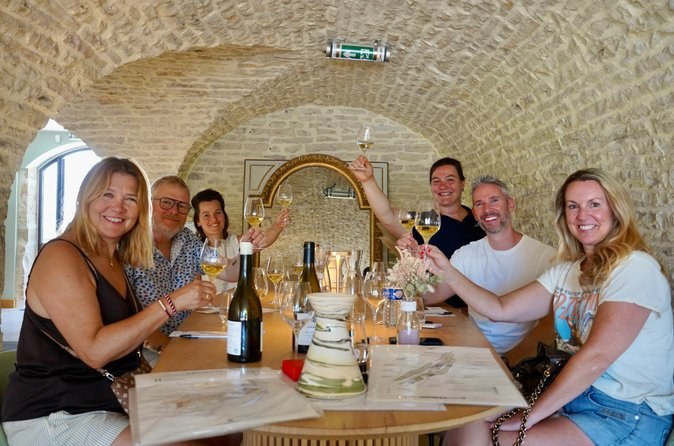
The six-wine cellar tasting
Rue Berbisey
Les Caves de La Fine Heure, 32 rue Berbisey
By the slot you book
The five-wine cellar tasting
Saint-Bénigne cathedral
La Source des Vins, opposite the cathedral
By the slot you book
Four wines, four cheeses
Beaune
The Hospices de Beaune; 2 rue de l'Hôtel-Dieu; the tourist office car park, 6 boulevard Perpreuil
11 am; 10:15 am; 9:30 am
The Beaune options of two shared days; two private days
The private days skip the table: they collect you from your hotel. The vintage van meets
at a hotel reception named on your booking. The pickup areas are on where to stay.
Two meeting points share Place Darcy. The full
days meet at Maison Divia, 16 Place Darcy; the Côte de Beaune half-day meets in the car park
beside Darcy park. Check which your confirmation names, and arrive 10 minutes early. If
you want a bed a short walk from it, see where to stay near
your kerb.
The first kilometre of the Route des Grands Crus
The Route des Grands Crus starts at kilometre zero in Dijon and runs south to Beaune and
Santenay. The Cité internationale de la gastronomie et du vin stands at its first
kilometre. From there, the road follows the foot of the slope, village by village.
UNESCO's Climats cover that slope for 50 km south of Dijon, as far as Maranges. So a day
between Dijon and Beaune is spent in the listed vineyards, whichever way it drives.
The Côte de Nuits villages, north to south
These are the villages in the order your van or bike reaches them.
Marsannay-la-Côte: the city's own appellation, where the two-day tour
starts its first day.
Gevrey-Chambertin: the first Grand Cru village, and the first tasting on
the Côte de Nuits days.
Vougeot: the walled Clos de Vougeot. One private day goes inside; the
Dijon-and-Beaune lunch day stops for a photo.
Vosne-Romanée: the Romanée-Conti vineyard, seen from the road.
Nuits-Saint-Georges: the town that names the Côte, an hour's stop on
the e-bike day.
The half-days turn back somewhere on this stretch. The 9 am half-day tastes in
Gevrey-Chambertin, then around Nuits-Saint-Georges or up in the Hautes-Côtes, and is back at
Place Darcy about four hours after it left. The full days drive on south, into the Côte de
Beaune.
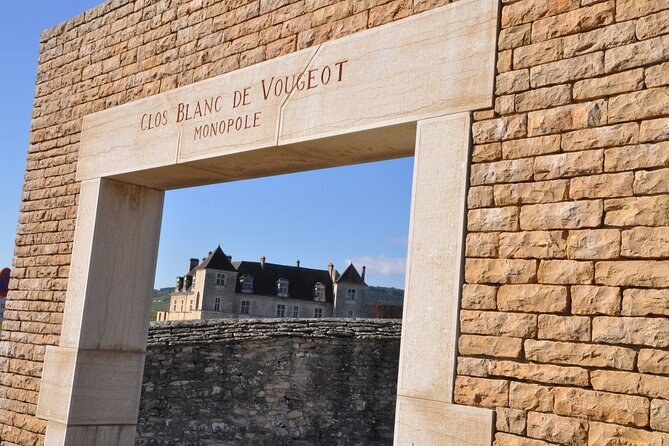
A stone gateway cut Clos Blanc de Vougeot, the château's roofs framed inside it
The Côte de Beaune and Beaune's meeting points
South of Nuits-Saint-Georges, the Côte de Beaune runs past Aloxe-Corton and its hill to
Beaune. Beyond Beaune lie Meursault and Puligny-Montrachet, the white-wine villages. The
white-wine lunch day spends about two hours in each, and the Château de Meursault's cellar
holds 800,000 bottles, as the tourist office puts it.
Beaune has three meeting points for Dijon tours. The lunch day meets at the Hospices de
Beaune at 11 am, and the e-bike day at 2 rue de l'Hôtel-Dieu at 10:15 am. Two private days
can meet in the tourist office car park at 6 boulevard Perpreuil at 9:30 am.
The Auxois villages west of Dijon
One day turns west instead of south. The villages day leaves 16 Place Darcy at 9 am for
the Auxois, away from the vines.
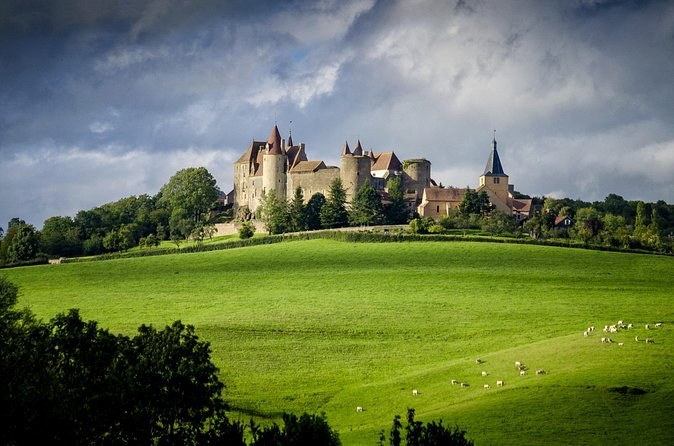
It spends 2 hours 30 minutes in Flavigny-sur-Ozerain, the abbey village, and 3 hours in
Semur-en-Auxois, with its Notre-Dame and ramparts. It ends at Châteauneuf-en-Auxois, a
château village on a hill. It pours no wine, and costs $243 a head.
The station, the Cité and the centre
The station sits at the west edge of the old centre. Place Darcy lies between them, a
short walk from the platforms. The Cité is about 10 minutes' walk from the station and 15
from the centre, on tram T2.
The tourist office is at 11 rue des Forges, in the Palais des États, in the old centre.
Rue Monge leads toward the Cité. So every Dijon kerb is a walk from the others.
Map of Dijon and the Côte
Dijon and the Côte d'Or
The city to the north, Beaune to the south, the villages between
The map loads from Google only when you press the button. Dijon is at the top. The wine
villages lie in a line along the slope to the south, with Beaune near the bottom.
Map questions
Where do Dijon wine tours start?
Most shared days meet at 16 Place Darcy or in front of Saint-Bénigne. The bike days leave 78 rue Monge, and the cellar tastings are in their own cellars in the centre.
Where does the Route des Grands Crus start?
At kilometre zero in Dijon. It runs south through the Côte de Nuits and the Côte de Beaune to Beaune and Santenay.
How far south do the UNESCO Climats run?
About 50 km south of Dijon, as far as Maranges. The listing also includes the historic centre of Dijon.
Can I join a Dijon wine tour in Beaune?
Yes, on two shared days: at the Hospices de Beaune at 11 am, or at 2 rue de l'Hôtel-Dieu at 10:15 am for the e-bike day. The private days also collect you in Beaune.
Where these facts come from
The route comes from Dijon's tourist office, the Climats from UNESCO, the Cité's access
from the Cité, and each kerb from its tour's own booking page. Verify before you travel.
Eight hours by minivan from 16 Place Darcy at 9 am to the Auxois: Flavigny-sur-Ozerain, Semur-en-Auxois and hilltop Châteauneuf-en-Auxois. No wine tasting is in the fare, and food and drinks are yours.
From Saint-Bénigne church at 9:45 am to the white-wine villages: two hours at a Puligny-Montrachet winery, two in the Meursault cellars, lunch in the fare, and back in Dijon at 5 pm.
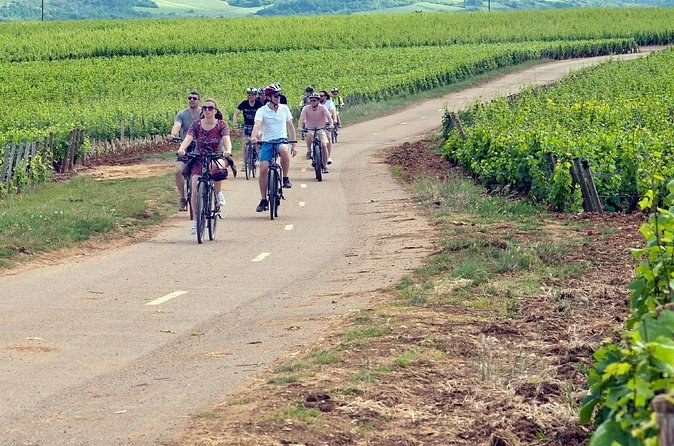
An e-bike day from 78 rue Monge at 9:30 am: a Gevrey-Chambertin cellar, the ride past the Clos de Vougeot to the Romanée-Conti vineyard, an hour in Nuits-Saint-Georges, and lunch in the fare.