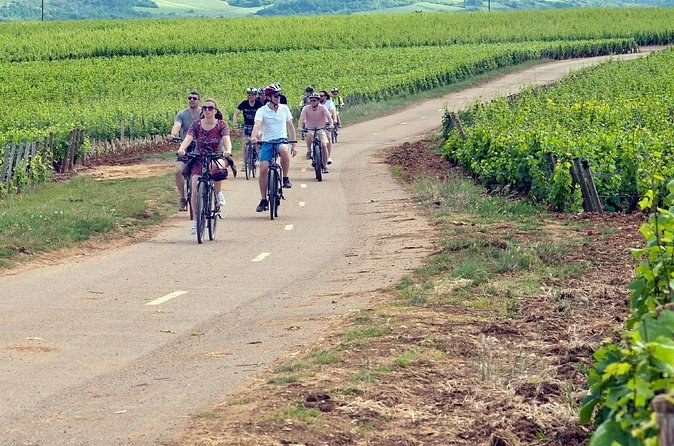
Dijon Wine Country: the Côte de Nuits and Côte de Beaune
Hours, prices and access verified by the Dijon Wine Tours team — last checked 2026-09-25.
The vineyards begin where Dijon ends. South of the city, one slope of vines
runs past the villages whose names you know from labels: Gevrey-Chambertin, Vougeot,
Meursault. Learn the order of those villages, and you can read the route of any
Dijon Wine tour at a glance.
From kilometre zero: the Route des Grands Crus leaves Dijon
The Route des Grands Crus has its kilometre zero in Dijon. From there it runs south to
Beaune and Santenay, through the villages the tours stop in. The Cité internationale de la
gastronomie et du vin stands at its first kilometre.
The slope splits in two. The northern half is the Côte de Nuits, from Marsannay to
Nuits-Saint-Georges. The southern half is the Côte de Beaune, with Beaune near its top and
the great white villages further south. Together they make the Côte d'Or.
The Côte de Nuits, village by village
This is the side nearest Dijon, and most half-days spend their hours here. The villages
sit close together, so you pass several in a morning.
Village, north to south
What it is known for
The days that stop there
Marsannay-la-Côte
The Côte de Dijon's own appellation, 600 ha
The two-day private tour starts here
Gevrey-Chambertin
The first Grand Cru village south of Dijon
The full day and the half-day from Place Darcy, the e-bike day (two cellars), a private Côte de Nuits day
Vougeot
The walled Clos de Vougeot and its château
One private day includes the entry; another leaves it optional; the e-bike day rides past
Vosne-Romanée
The Romanée-Conti vineyard
A private day tastes at an artisan winery here; the vintage van and the e-bike day drive or ride to the vineyard
Nuits-Saint-Georges
The town that names the Côte de Nuits
The e-bike day stops an hour; one half-day tastes here or in the Hautes-Côtes
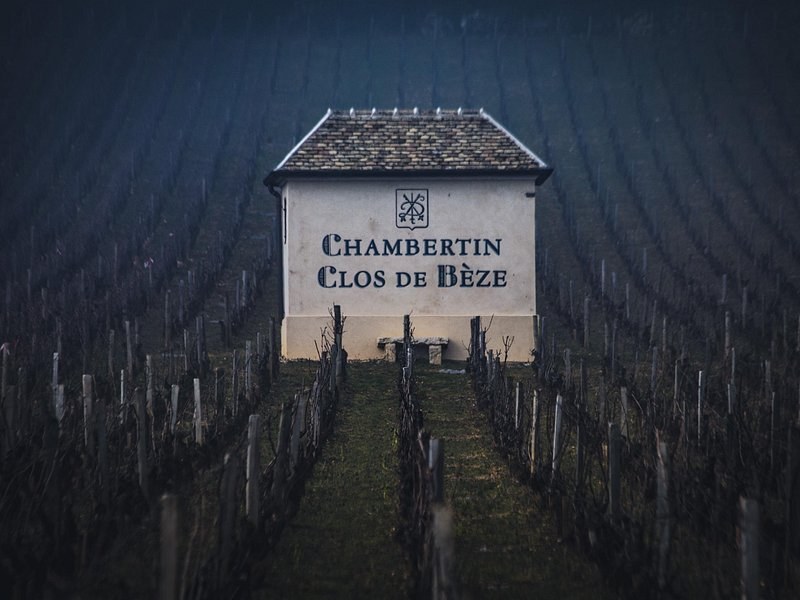
Gevrey-Chambertin is where the Côte de Nuits days usually pour first. The Ophorus half-day spends two
hours at a winery there, and the e-bike day starts and ends its ride with a cellar in the
village.
A stone hut painted Chambertin Clos de Bèze, lit among dark vine rows
The Côte de Beaune, village by village
South of Nuits-Saint-Georges the Côte de Beaune begins. The full days reach it, and the
days built around white wine spend most of their time here.
Village, north to south
What it is known for
The days that stop there
Aloxe-Corton
The hill of Corton
The 9:45 am full day stops for the view; day 2 of the two-day tour
Beaune
The Hospices and the wine trade
Lunch or free time on several full days; the Ophorus day tastes here
Meursault
White wine, and a château cellar of 800,000 bottles
The white-wine day (2 hours), the e-bike day's start, the Ophorus day's third winery
Puligny-Montrachet
The Montrachet white wines
The white-wine day spends 2 hours 15 minutes; the e-bike day rides toward Montrachet
If you prefer white wine, this is your side. The white-wine day from Saint-Bénigne gives
Puligny-Montrachet and Meursault two hours each, and puts lunch in the fare.
The Climats and the UNESCO listing
A climat is a vineyard parcel with its own soil, slope and exposure, marked out on the
ground. UNESCO listed 1,247 of them in 2015, on the slopes of the Côte de Nuits and the Côte
de Beaune. They extend 50 km south of Dijon, as far as Maranges.
The listing has a second part: the historic centre of Dijon, where the rules that named
and protected each parcel were made. The appellation decrees that still govern them date
from 1936. So the listing is the Climats and the town, not the road that links them.
The Côte de Dijon: a vineyard coming back
Until the late 19th century, more than a thousand hectares of vines grew inside Dijon.
Until the 18th century, crus such as Les Marcs-d'Or and Les Champs-Perdrix rivalled the
great whites of Meursault. Then the city built over them.
Today Marsannay-la-Côte, at the city's edge, holds its own appellation with 600 hectares.
Dijon Métropole farms 8 hectares at the Domaine de La Cras. It plans to replant 50 of the
300 hectares zoned for AOC Bourgogne, with 2.5 hectares set aside to test Pinot Noir and
Chardonnay against a warmer climate.
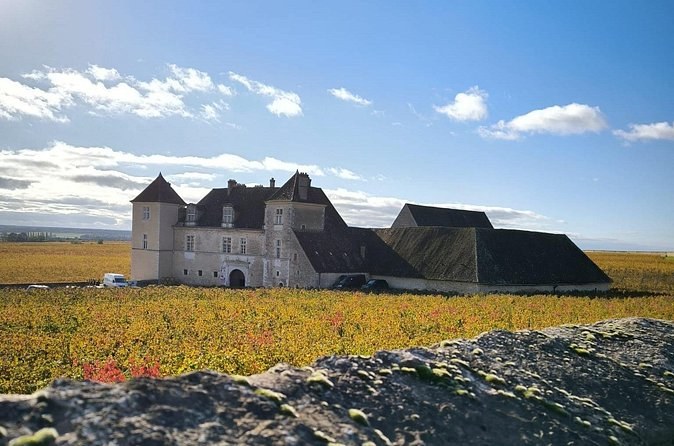
The Clos de Vougeot: 51 walled hectares
Monks of the Abbey of Cîteaux founded the Clos de Vougeot in the 12th century as a wine
farm. A Renaissance château followed in the 16th century. Inside you see the medieval
presses and the vat-house. Since 1945 it has been the seat of the Confrérie des Chevaliers
du Tastevin.
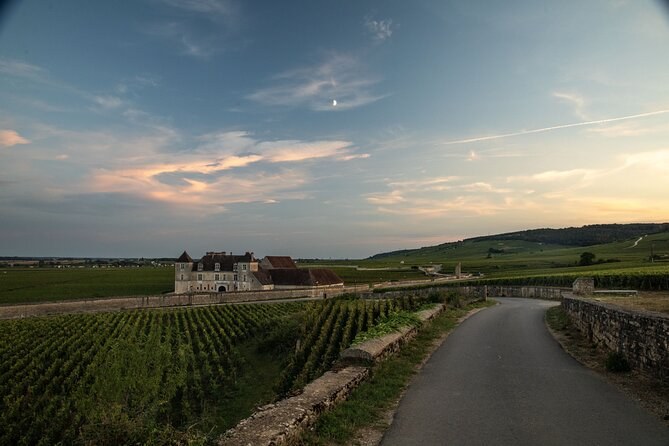
Its wall still closes almost 51 hectares of vines in one piece. The château opens daily,
and the guided tour in English runs twice a day.
Season
Château open
Desk closes
English guided tour
1 April to 31 October
9:30 am–6 pm, daily
5:30 pm
11:30 am and 3:30 pm, EUR 15
1 November to 31 March
10 am–5 pm, daily
4:30 pm
11:30 am and 3:30 pm, EUR 15
Only one day puts the entry in the fare: the private day that picks you up in Dijon
or Beaune at 9 am. It gives the château an hour, then tastes at an artisan winery in
Vosne-Romanée. The private Côte de Nuits day stops outside and leaves the visit optional,
at your cost.
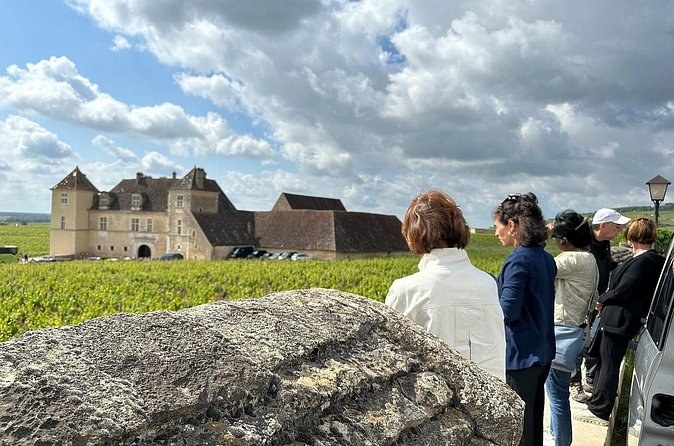
The Clos de Vougeot's château behind its walled vineyard, the vines turning gold
Want the château and a cellar in one day?
The private day with the Clos de Vougeot entry picks you up at 9 am and goes on to an estate in Vosne-Romanée.
Romanée-Conti is a Grand Cru vineyard in Vosne-Romanée. You see it the way nearly every
visitor does: from the edge of the vines. The vintage
van drives the road between Chambertin and Romanée-Conti. The e-bike day rides to it.
None of these days goes inside the domaine or pours its wine. Take the photograph, then
taste the village's other wines at the estate your day books.
Grapes and appellations by the numbers
The BIVB counts 28,841 hectares of vines in the region, 3% of French wine growing, over
230 km. Two grapes dominate. The figures below are by vineyard area and by what is made.
Grape
Share of the vineyard
Chardonnay
57%
Pinot Noir
34%
Aligoté
6%
Other grapes
3%
Wine
Share of what is made
White
62%
Red
29%
Crémant de Bourgogne
8%
Rosé
1%
Both grapes grow along the whole Côte. The Côte de Nuits days lean red, around the Grand
Cru villages. The Côte de Beaune days lean white. The Aligoté you taste on the city ride is
the region's third grape.
Questions about the vineyards
How far are the vineyards from Dijon?
They start at the city's edge. The Route des Grands Crus has its kilometre zero in Dijon, and the Côte de Nuits half-days reach their first winery after a short drive.
Can I visit Romanée-Conti?
You can see the vineyard in Vosne-Romanée from the road beside it. The vintage van and the e-bike day go there, and a private Côte de Nuits day stops at it. None of them visits inside the domaine.
Is Dijon part of the UNESCO listing?
Yes. UNESCO's Climats of Burgundy take in the historic centre of Dijon as well as the vineyard parcels south of it. It names the Ducal Palace as one trace of the system.
How much is the guided tour of the Clos de Vougeot?
EUR 15 for an adult and EUR 7 for ages 8 to 16 and students, by reservation. The English tour runs at 11:30 am and 3:30 pm.
Where these facts come from
The figures come from the BIVB, the Climats from UNESCO, the route and the Côte de Dijon
from Dijon's tourist office, the château from the Clos de Vougeot, and each stop from its
tour's booking page. Verify before you travel.
A private day from your Dijon or Beaune hotel at 9 am: an hour inside the Clos de Vougeot with the entry paid, eight wines at two family estates, and lunch in Beaune at your cost.
A private minivan from your hotel, Place Darcy or Beaune at 9:30 am through the Côte de Nuits: Gevrey-Chambertin, the Romanée-Conti vineyard, 10 to 15 wines. The Clos de Vougeot entry is optional and extra.
An e-bike day from 78 rue Monge at 9:30 am: a Gevrey-Chambertin cellar, the ride past the Clos de Vougeot to the Romanée-Conti vineyard, an hour in Nuits-Saint-Georges, and lunch in the fare.